Data Centers: The Invisible Energy and Environmental Cost of the Digital Economy
Data centers are no longer merely “server rooms”; they are the physical infrastructure behind cloud computing, artificial intelligence, financial transactions, health data, e-commerce, cybersecurity, public services, and industrial automation. As digitalization accelerates, data centers are becoming critical energy consumers operating in the background of the economy. The fundamental question today is not whether data centers are needed, but with what energy sources, in which geographies, and at what water and land cost this infrastructure will expand.
Current State: Country-Scale Consumption at the Global Level
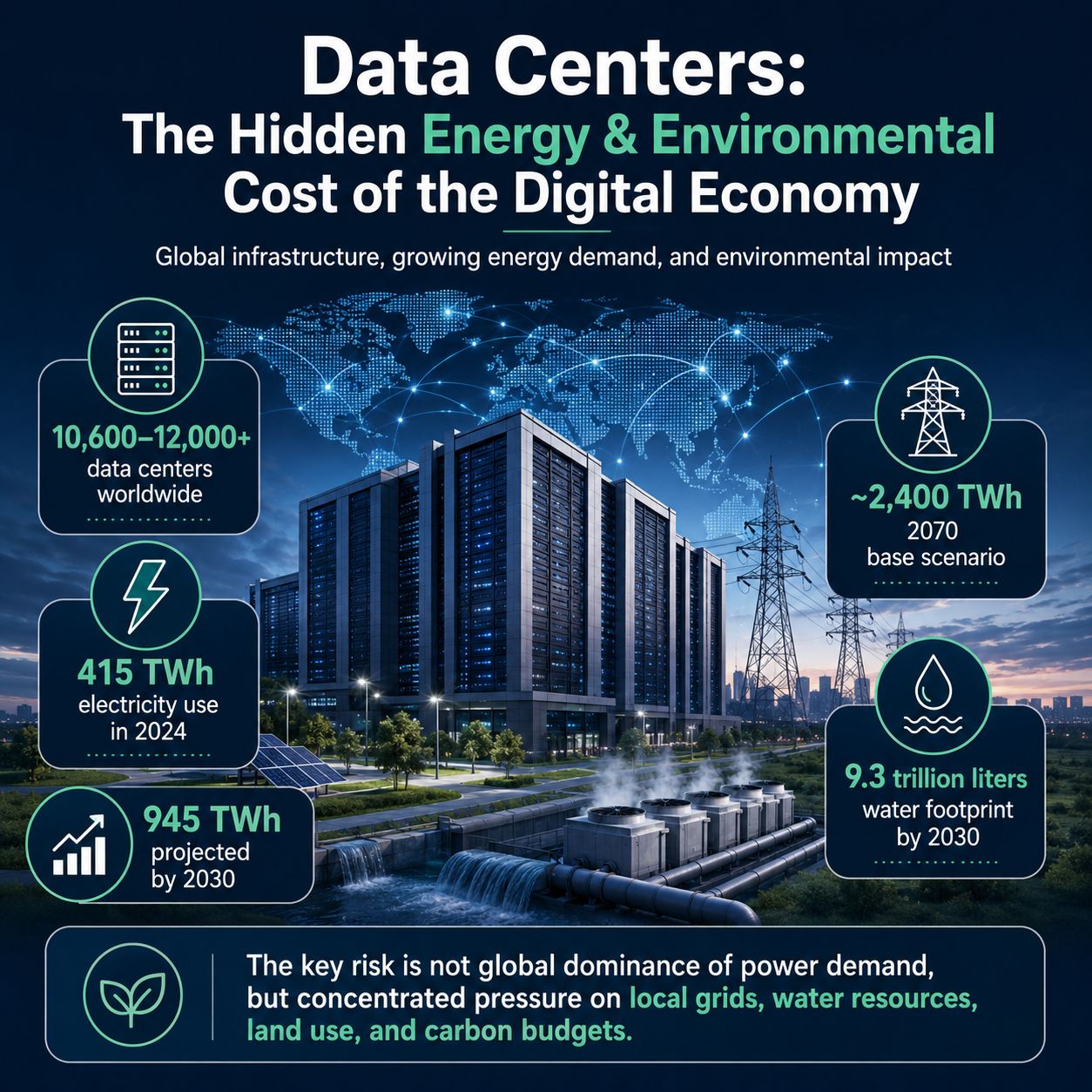
According to the International Energy Agency, data centers consumed approximately 415 TWh of electricity in 2024. This corresponds to roughly 1.5% of global electricity consumption. For 2025, the United Nations University assessment estimates consumption at 448 TWh; if treated as a country, this level of consumption would make data centers one of the world’s largest electricity consumers. [K1][K5]
The capacity of this infrastructure cannot be measured solely in megawatts or terawatt-hours. Data centers combine storage, high-speed network connectivity, uninterrupted power, cooling, backup systems, disaster recovery, GPU/TPU-based accelerated computing, and low-latency service delivery. Traditional enterprise data centers remain important; however, the center of growth is shifting toward colocation facilities, cloud service providers, and hyperscale facilities. On the artificial intelligence side, it is not training alone but the “inference” workloads serving billions of daily queries that make energy demand persistent. According to UNU-INWEH, 80–90% of AI energy use may arise from the inference process after models are deployed. [K5]
Where Does the Environmental Harm Originate?
The environmental impact of data centers is not limited to electricity consumption. The issue is concentrated under four main headings:
- Carbon emissions: When electricity comes from fossil-fuel-heavy grids, data center growth directly translates into carbon emissions. According to IEA analysis, the current physical electricity mix consumed by data centers is approximately 30% coal, 27% renewables, 26% natural gas, and 15% nuclear. Although a significant portion of rising demand through 2030 is expected to be met by renewables, natural gas and coal will remain critical system complements in the short term. [K2]
- Water consumption: Data centers may use water directly for cooling; in addition, electricity generation itself creates a water footprint. UNU-INWEH states that the water footprint associated with data center electricity could reach 9.3 trillion liters in 2030. This magnitude is expressed as equivalent to the basic annual domestic water needs of 1.3 billion people in Sub-Saharan Africa. [K5]
- Land, grid, and local pressure: The impact of data centers may appear limited at the global level, but it is highly concentrated locally. For example, data centers accounted for 21% of Ireland’s metered total electricity consumption in 2023. This shows that new grid connection permits, transmission capacity, and water management can become strategic bottlenecks in specific regions. [K5]
- Hardware lifecycle and e-waste: AI accelerators, servers, power electronics, and cooling equipment have short replacement cycles. UNU-INWEH projects that AI-related electronic waste could reach 2.5 million tons per year by 2030. This means the environmental burden arises not only at the location of the data center, but also across the critical mineral extraction, manufacturing, and waste-processing chain. [K5]
2027, 2030, and 2070 Energy Scenario
In the short term, the most reliable reference is the IEA’s 2030 projection. Under the IEA base scenario, data center electricity consumption rises to 945 TWh in 2030; this represents more than a doubling compared with 2024 and approximately 3% of global electricity demand in 2030. The IEA expects global electricity consumption to increase from 28,200 TWh in 2025 to 33,600 TWh in 2030. [K1][K3]
For 2027, instead of a single official global forecast, applying the IEA 2024–2030 growth trajectory suggests data center consumption of approximately 630 TWh per year. This indicates that by around 2027, data centers will approach the 2% band in the global electricity system.
| Year | Data center electricity requirement | Approximate share of global electricity | Comment |
| 2024 | 415 TWh | 1.5% | Current reference level |
| 2030 | 945 TWh | ~2.8–3% | Scale close to or above Japan’s current annual consumption |
| 2070 base | ~2,400 TWh | ~3.5% | Long-term base scenario used in this article |
| 2070 stress | ~6,600 TWh | ~9–10% | Extreme scenario in which efficiency gains are absorbed by the rebound effect |
The 2070 projection is naturally not an official forecast; it is a stress test based on explicit assumptions. In the base scenario, it is assumed that after 2035 data center electricity demand grows at an average annual rate of around 2%, while global electricity demand expands with electrification to approximately 68,000–70,000 TWh by 2070. Under this assumption, data centers consume 2,400 TWh per year of electricity in 2070. This level is about 2.5 times the data center demand projected for 2030 and approximately 6.7 times Türkiye’s total electricity consumption in 2025. [K3][K6]
In the high scenario, the 2070 requirement approaches 4,000 TWh per year; this corresponds to approximately 11 times Türkiye’s 2025 electricity consumption. In the extreme stress scenario, consumption of 6,600 TWh per year could approach 10% of global electricity. The main risk is not that “most of the world’s energy will be diverted to data centers,” but that data centers will create disproportionate pressure in specific cities, regions, and grid nodes.
Are Current Energy Resources Sufficient?
At the global level, it is theoretically possible to generate enough electricity to meet data center demand through 2030. According to the IEA, renewables can supply roughly half of the increase in data center electricity demand by 2030; however, natural gas and coal will continue to support a significant share of demand. Therefore, the issue is not merely “is there enough electricity?” but rather “can this electricity be low-carbon, continuous, grid-connectable, and supplied without creating local water or land pressure?” [K2]
On the path to 2070, a sustainable roadmap depends on a combination of renewable energy, batteries and long-duration storage, continuous low-carbon sources such as nuclear/SMRs, waste heat utilization, water-efficient cooling, regional capacity planning, and mandatory environmental reporting. The European Commission’s focus on energy performance and environmental reporting obligations for data centers shows that the sector is no longer only a technology issue; it is also an energy and environmental policy issue. [K4]
Because there is no single official registry that provides the exact number of data centers worldwide, the total count is tracked through sectoral databases. Current databases indicate that, as of late 2025 to early 2026, there are approximately 10,600–12,000+ operational data centers globally. This infrastructure is geographically highly concentrated: the United States ranks first by a wide margin with approximately 5,427 facilities, followed by Germany, the United Kingdom, China, Canada, France, Australia, the Netherlands, Russia, and Japan. At the regional level, North America hosts approximately 5,700+ data centers, Europe 3,300+, and Asia-Pacific 1,800+. [K7] The natural resource requirement arises less from fuel burned directly inside data centers and more from the generation mix of the electricity supplied to these facilities: according to the IEA, approximately 460 TWh of electricity was generated to supply data centers in 2024; around 30% of this came from coal, 26% from natural gas, 27% from renewables, and 15% from nuclear. [K2] When this physical resource mix is translated using the EIA’s average electricity generation coefficients, today’s data center ecosystem corresponds to approximately 71 million tons of coal and 25 billion m³ of natural gas equivalent in fossil fuel consumption; the water footprint, back-scaled from the 9.3 trillion liter value projected for 2030 based on electricity demand, is approximately 4 trillion liters per year. [K5][K8] In 2030, electricity generation required for data centers is expected to exceed 1,000 TWh; if today’s fossil intensity remains unchanged, this would imply approximately 155 million tons of coal, 55 billion m³ of natural gas, and a water footprint of 9.3 trillion liters per year. In the 2070 base scenario, when annual data center electricity demand reaches 2,400 TWh, the corresponding fossil burden would be approximately 372 million tons of coal and 131 billion m³ of natural gas if today’s resource mix is maintained; however, even under a more realistic low-carbon transition scenario in which the fossil share falls to 15%, the system may still require fossil resources equivalent to approximately 87 million tons of coal and 40 billion m³ of natural gas. Therefore, the long-term risk is not only “fuel availability,” but whether continuous low-carbon electricity, grid connection, water-efficient cooling, site selection, and local ecosystem carrying capacity can be managed simultaneously.
Data centers are indispensable infrastructure for the modern economy; however, growth becomes unsustainable when their environmental cost remains “invisible.” Data center electricity consumption is expected to rise to approximately 945 TWh by 2030. In the 2070 base scenario, this requirement could reach 2,400 TWh per year. This is not a share large enough to capture the global electricity system on its own, but it is large enough to exert decisive pressure on local grids, water resources, land use, and the carbon budget.
For this reason, the sector’s main strategy should not be limited to building more data centers. The right strategy is to plan computing demand together with energy, water, land, and carbon budgets; locate data centers in regions with low-carbon electricity and low water footprints; manage the hardware lifecycle; and apply demand discipline alongside efficiency in AI use. The sustainability of the digital economy will depend less on how much data centers grow and more on which resources, and within which environmental limits, this growth is managed.
TUYAD closely monitors developments related to the growing energy demand of data centers, their environmental impacts, and the sustainability of digital infrastructure. While the Association continues its efforts to provide industry stakeholders with up-to-date reports, technical insights, and sectoral assessments, Hayrettin ÖZAYDIN – President of TUYAD drew attention to the rapid increase in global energy demand, stating that in long-term scenarios, the energy pressure created by data centers and digital infrastructure may become more pronounced. He also noted that, unless the necessary planning is carried out, regional risks may emerge in terms of energy supply and grid capacity. In this context, TUYAD emphasizes that the sector must act not only in response to today’s requirements, but also with sensitivity to the future limits of energy, water, land use, and carbon budgets. The Association further underlines the critical importance of developing environmentally responsible, efficient, and long-term policies to ensure that digital transformation advances on a sustainable foundation.