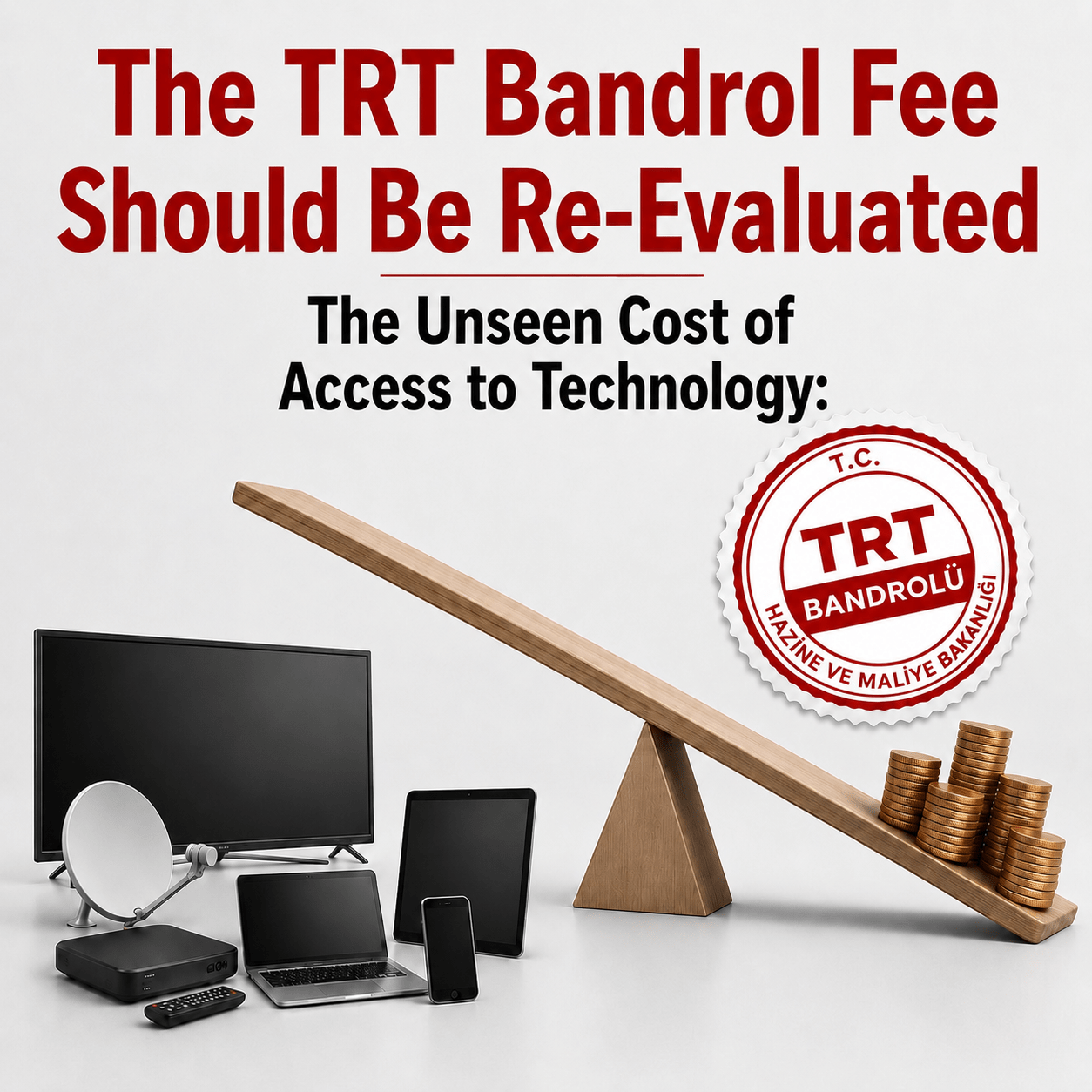
The Hidden Cost of Access to Technology: The TRT Bandrol Fee Should Be Reassessed
Today, products such as televisions, satellite receivers, set-top boxes, tablets, computers, and smartphones are no longer merely electronic devices. They have become essential tools for accessing information, education, news, digital broadcasting services, reliable communication during emergencies, and household connectivity infrastructure. As access to technology becomes increasingly important, the cost structure imposed on these products should be re-evaluated from the perspectives of public benefit, sustainable production, and consumer accessibility.
The TRT bandrol fee is a public revenue mechanism applied to certain devices under the relevant legislation. Under the current system, manufacturers and importers of devices subject to the bandrol fee are considered liable parties. The fee is calculated based on the VAT assessment base excluding SCT (Special Consumption Tax): for imported products, on the Customs Entry Declaration value, and for domestically manufactured products, on the sales invoice value.
Under the current framework, TRT bandrol fees are applied at a rate of 16% on televisions and 12% on satellite receivers, set-top media boxes, and TV tuner cards. As a result, the fee automatically increases as the taxable value of the product rises.
For manufacturers, producers, and importers, several key challenges stand out:
* The system creates a need for upfront financing during production and import processes.
* Guarantee, declaration, payment, and monitoring requirements generate additional administrative burdens.
* The percentage-based calculation model creates variable and often unpredictable costs linked directly to product value.
* Competitive imbalances may arise between companies that fully comply with bandrol obligations and those that market products without bandrol compliance or with incomplete declarations.
This situation affects not only the cost structures of businesses but also the protection of legitimate trade and consumers’ access to safe and reliable products. Our sector’s position is clear: public revenues must be preserved. However, the method of collection should not create excessive financial pressure on compliant businesses, hinder production, or weaken fair competition. Therefore, a new perspective on the TRT bandrol system is needed.
First, a fixed-fee model based on product categories should be considered instead of the current percentage-based calculation. A fixed tariff could provide greater cost predictability for businesses while offering a simpler and more transparent collection mechanism for public authorities.
Second, alternative collection methods that reduce the upfront financing burden on manufacturers and importers should be examined. In various countries, public broadcasting contributions are collected through household fees, user-based payments, periodic contributions, or general taxation systems. Türkiye may also evaluate models that protect public revenues without imposing additional financial burdens on producers.
Third, bandrol compliance controls should be strengthened not only during manufacturing and import stages but also throughout sales channels. Retail stores, online sales platforms, and marketplaces should become integral parts of the compliance and monitoring chain. Such an approach would help protect compliant businesses while contributing to the fight against unregistered and undocumented sales.
**At the sector evaluation meeting organized by TUYAD on May 21, leading manufacturers and industry representatives from Türkiye came together to assess the current implementation of the TRT bandrol system, its impact on the industry, and potential solutions through a collaborative approach. The recommendations presented in this statement reflect not only the position of our association but also the shared views and assessments of the participating companies and sector representatives. TUYAD remains committed to advancing this initiative by informing relevant public institutions, conveying industry opinions to government authorities, and maintaining the necessary dialogue to ensure that the issue is placed on the agenda of the relevant ministries.**
A new balance in the TRT bandrol system should simultaneously aim to protect public broadcasting revenues, distribute obligations more fairly among manufacturers and importers, strengthen legitimate trade, and ensure consumers’ access to reliable products.
Türkiye’s electronics, satellite, and broadcasting technology sector continues to produce, innovate, create employment, and contribute to the country’s digital transformation. To ensure the sustainability of these contributions, the financial and administrative burdens placed on the sector must be reassessed in line with the realities of the modern era.
TUYAD
Telecommunications, Satellite and Electronics Industrialists and Business People Association
#NewBalanceInTRTBandrol
#StrongProductionStrongTürkiye
#ProducerFriendlyTRTBandrolFee