
OTT Platforms in Turkey: The New Broadcasting Economy Transforming Viewing Habits
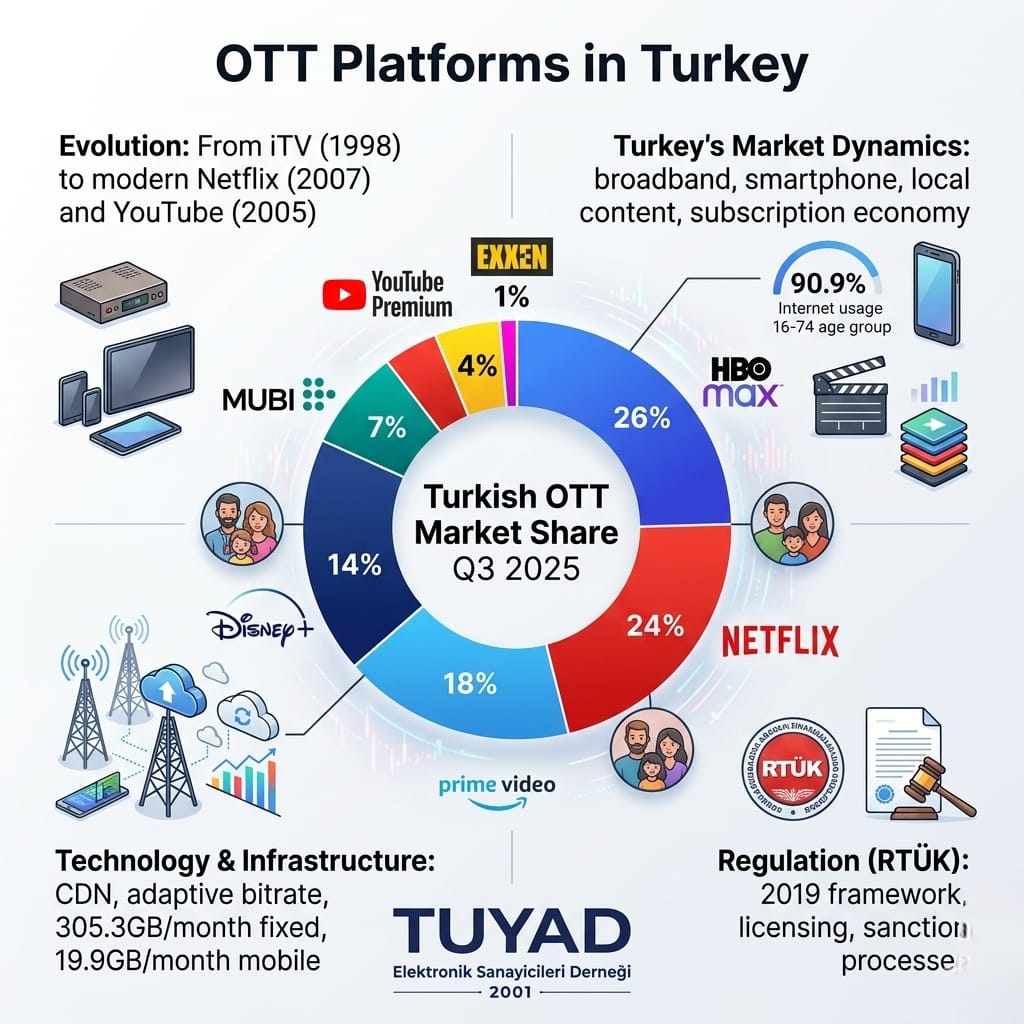
OTT comes from the English term “Over-the-Top” and refers to the delivery of video, audio, or media content directly to users over the internet, instead of through traditional terrestrial broadcasting, cable, satellite, or IPTV distribution models. In other words, OTT allows viewers to watch content whenever they want, on smart TVs, phones, tablets, computers, or gaming consoles, without being tied to a television schedule. The emergence of this model is driven by users’ demand for “on-demand, less ad exposure, personalized, and multi-device” content consumption. One of the early examples of OTT was iTV, a video-on-demand service launched by Hong Kong Telecom in 1998; the modern global breakthrough accelerated with YouTube popularizing video sharing in 2005 and Netflix launching its streaming service in 2007.
The growth of OTT in Turkey is closely linked to the widespread adoption of broadband internet, smartphone penetration, local content production, and the development of the subscription economy. According to TÜİK’s 2025 Household Information Technologies Usage Survey, internet usage among the 16–74 age group has reached 90.9%. This indicates that OTT services are no longer niche but have become a mainstream media consumption channel.
On the infrastructure side, official statistics from BTK for the third quarter of 2025 show that Turkey has 98.24 million total broadband subscribers, 76.52 million mobile internet subscribers, and 9.29 million fiber subscribers. During the same period, total broadband internet traffic reached 23.21 million terabytes, with average monthly data usage per subscriber at 305.3 GB for fixed and 19.9 GB for mobile. These figures demonstrate that video consumption has become one of the most critical loads on telecom infrastructure.
From a regulatory perspective, internet-based radio, television, and on-demand broadcasting services in Turkey are subject to RTÜK regulations. The internet broadcasting regulation enacted in 2019 introduced frameworks such as internet broadcasting licenses, on-demand broadcasting service licenses, and transmission authorizations. It also specifies that licenses are granted for ten years and outlines application and sanction processes for unlicensed broadcasting.
Major OTT platforms in the Turkish market include Netflix, HBO Max, Prime Video, Disney+, MUBI, Exxen, Gain, TV+, Tivibu Go, and TRT’s platform tabii. Netflix strengthened its localization in Turkey in 2016 by offering Turkish language support and payment in Turkish Lira. Disney+ launched in Turkey on June 14, 2022. Exxen started on January 1, 2021, and TRT’s international digital platform tabii was introduced on May 7, 2023.
As of 2025, significant changes have occurred in market competition. With BluTV’s transformation into the Max/HBO Max structure, global catalogs, local content, and bundle partnerships have been consolidated under one roof. According to JustWatch data for Q3 2025, HBO Max leads with 26%, followed by Netflix at 24%, Prime Video at 18%, and Disney+ at 14%. MUBI holds 7%, YouTube Premium 4%, and Exxen 1%. This landscape indicates that Turkey has shifted from single-platform dominance to a “multi-subscription” and “content-driven platform choice” era.
Technologically, OTT platforms rely on several core components: CDN (content delivery networks), adaptive bitrate streaming, cloud-based scaling, recommendation algorithms based on user behavior, digital rights management, multi-profile structures, and offline viewing. For end users, these mean less buffering, automatic quality adjustment based on internet speed, personalized recommendations, and continuity across devices. For the industry, data has become as strategic as content itself—metrics such as how much content is watched, where viewers drop off, and which genres retain subscribers directly influence investment decisions.
In the coming period, three dynamics will shape Turkey’s OTT market: price sensitivity, the strength of local content, and sports/live broadcasting rights. On the user side, as subscription costs rise, models such as seasonal memberships, family packages, ad-supported lower-cost plans, and operator bundles will gain importance. On the industry side, local series, documentaries, children’s content, and sports rights will become key differentiation factors. Therefore, OTT is not just about watching series and movies over the internet; it is a next-generation broadcasting ecosystem that simultaneously impacts telecommunications, media, advertising, data analytics, and cultural exports.
Association of Telecommunications, Satellite and Electronics Industrialists and Businesspeople (TUYAD), which brings together companies operating in satellite communication, television broadcasting, electronic communication systems, and information technologies in Turkey, is an important sectoral organization closely monitoring the transformation in OTT and internet-based broadcasting. Under the leadership of Chairman Hayrettin Özaydın, the association follows developments in satellite, IPTV, digital broadcasting, next-generation communication infrastructures, and sectoral regulations, strengthens collaboration among stakeholders, and continues its efforts to support the sustainable development of broadcasting technologies in Turkey. In this respect, TUYAD plays a key institutional role in contributing to a more high-quality, reliable, and accessible digital broadcasting environment for both industry professionals and end users.


