
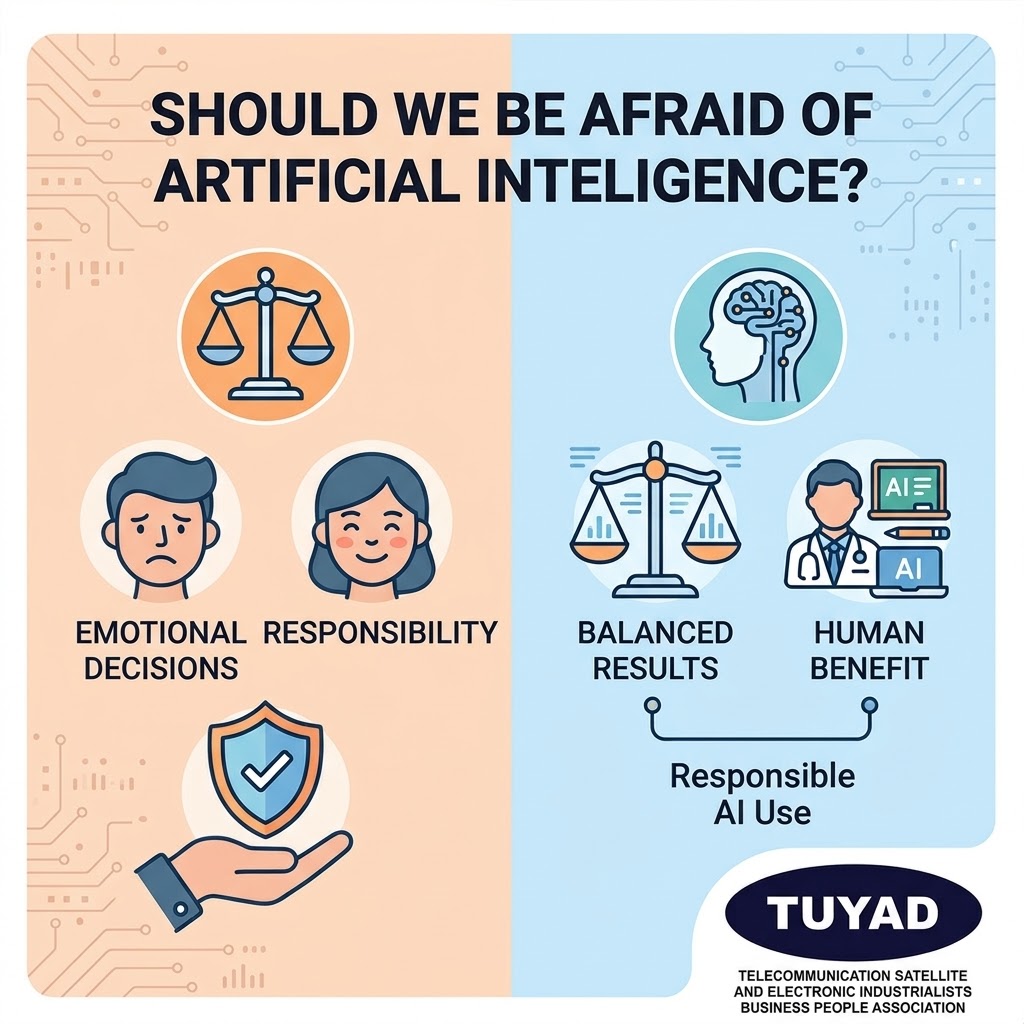
Should We Be Afraid of Artificial Intelligence?
The Question of Humanity, Technology and Control
Artificial intelligence is no longer a subject discussed only within the technology sector. From education and healthcare to communications, the defense industry, media, and finance, AI systems are becoming part of almost every area of our lives. This rapid development brings with it an important question: Should people be concerned about the uncontrolled growth of artificial intelligence?
In reality, what we should be concerned about is not technology itself, but rather how it is used, under what rules, for what purposes, and under whose control.
Throughout human history, almost every major technological transformation has created similar debates. The Industrial Revolution raised concerns that machines would replace human labor, while the spread of the internet brought questions of information security and privacy to the forefront. Today, we are experiencing a similar transformation with artificial intelligence.
However, there is one important characteristic that distinguishes AI from many previous technologies: these systems do not merely automate physical tasks. They can also write, analyze information, generate images, support decision-making processes, and develop models capable of understanding patterns in human behavior.
For this reason, the development of artificial intelligence is not merely a technical issue. It is also an ethical, legal, economic, and social matter.
Can Artificial Intelligence Be More “Humane” Than Humans?
At first glance, this question may appear contradictory. Artificial intelligence does not possess emotions, conscience, or human life experience. It does not love, feel sadness, experience compassion, or carry moral responsibility in the way human beings do.
Yet an interesting situation is emerging.
A well-designed AI system may, in certain circumstances, produce more balanced outcomes than a person whose decisions may be influenced by anger, prejudice, personal interests, or temporary emotional reactions. Such systems can be designed to apply the same principles without discriminating on the basis of language, identity, social status, or personal characteristics.
This does not make artificial intelligence truly “humane.” However, it can make AI a tool capable of applying human-defined values more consistently.
The critical point is this: the values embedded in artificial intelligence are still determined by humans.
The data on which a system is trained, the rules under which it is developed, and the purposes for which it is used all have a significant impact on its outcomes. Therefore, the question of whether artificial intelligence will behave ethically is, to a large extent, directly linked to the ethical standards of the people and institutions that develop and use it.
The Real Risk: Not the Loss of Control, but the Loss of Responsibility
Discussions about artificial intelligence sometimes focus on scenarios in which machines eventually take complete control over humanity. Yet there are more immediate and tangible risks that deserve attention today.
The rapid generation and spread of misinformation, misuse of personal data, AI-assisted fraud, cybersecurity threats, algorithmic discrimination, and the tendency to leave critical decisions to machines without sufficient human scrutiny are among the most significant concerns.
For this reason, one of the key questions of the future will not only be, “How powerful will artificial intelligence become?” but also “Who will be responsible when artificial intelligence is used?”
When an AI system makes an incorrect decision in critical areas such as healthcare, finance, communications, or public services, responsibility cannot simply be assigned to an algorithm. Human oversight, transparency, accountability, and appropriate legal frameworks must remain essential components of technological development.
Completely stopping technological progress is neither realistic nor desirable. The important issue is not to prevent development, but to determine its direction responsibly.
The Future Relationship Between Humans and Artificial Intelligence
Rather than viewing artificial intelligence as a competitor to humanity, it may be more productive to see it as a tool that can enhance human capabilities when used within appropriate boundaries.
AI applications that help doctors detect diseases earlier, enable teachers to develop more personalized educational programs, support engineers in designing safer systems, or allow people to access information more efficiently can offer significant benefits to society.
However, as technology becomes more advanced, human responsibility should not decrease. On the contrary, it should increase.
Because ultimately, humans will determine how “humane” artificial intelligence can be.
As TUYAD, We Closely Follow Technological Transformation
As TUYAD, we recognize that the transformation taking place across communications, broadcasting, digitalization, and connected technologies has entered a new phase with the development of artificial intelligence. We closely follow technological developments that may affect both our industry and society, and we believe that the opportunities created by innovation should be considered together with their ethical, legal, security, and social implications.
Rather than resisting technological progress, we believe it is essential to understand it, use it responsibly, and guide it toward the benefit of people and society. The future of artificial intelligence will not be determined solely by software and algorithms, but also by the values with which we develop these technologies and the sense of responsibility with which we use them.
The defining question of the future will not be whether humans or artificial intelligence will prevail. The real question will be what kind of future humanity chooses to build with artificial intelligence.
TUYAD


