
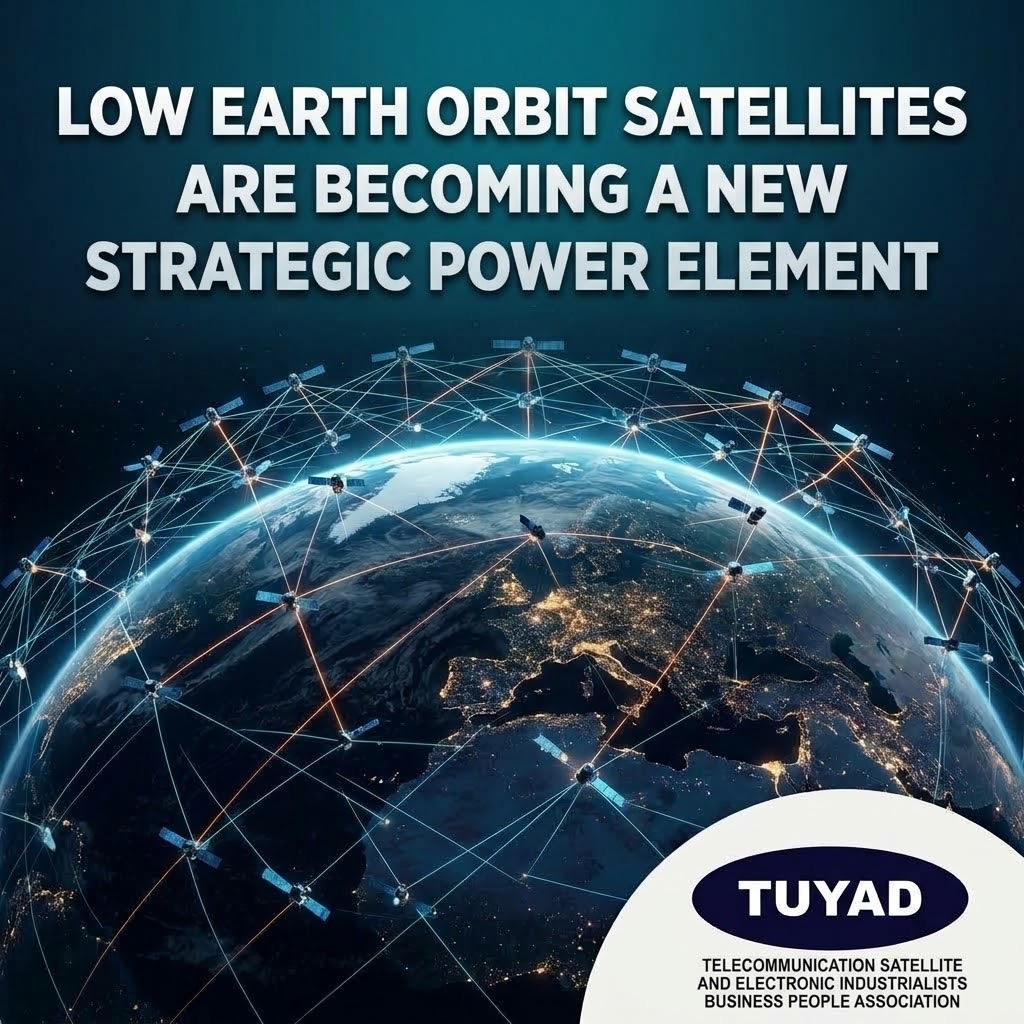
LOW EARTH ORBIT SATELLITES ARE BECOMING A NEW ELEMENT OF STRATEGIC POWER
Rapid advances in satellite technologies are significantlytransforming the role of space. In particular, Low Earth Orbit (LEO) satellites should no longer be viewed solely as systemsused for communications, internet access, observation, positioning, and navigation.
New-generation small satellites, which can be produced at lowercost, deployed into orbit more rapidly, and equipped with highmobility and maneuverability, are increasingly taking on criticalroles not only in civilian and commercial applications, but also in intelligence, reconnaissance, surveillance, early warning, target detection, secure communications, and defense.
One of the most significant developments in this new era is thepotential for such systems to evolve, through the integration of advanced technologies, into dual-use platforms capable not only of defensive functions but also of active intervention andoffensive operations.
A highly maneuverable satellite may be capable of approachinganother satellite in orbit, tracking its movements, or carrying outelectronic or physical actions that could affect its mission. Suchcapabilities are fundamentally changing the understanding of security in space. Likewise, these platforms may in the future be considered as components of anti-satellite (ASAT) systems, electronic warfare assets, or strategic platforms capable of carrying different mission payloads.
These developments demonstrate that the future of satellitetechnologies will depend not only on communications capacity, but also increasingly on maneuverability, autonomous missionmanagement, precision positioning, inter-satellitecommunications, resilience against electronic warfare, spacesituational awareness, and orbital security.
LEO constellations consisting of hundreds or even thousands of small satellites offer a more distributed and flexible architecturecompared with traditional large satellite systems. Their ability tomaintain overall system functionality even if one or severalsatellites become unavailable makes such architecturesincreasingly important from both economic and strategicperspectives.
For this reason, competition among nations in space is no longerlimited to the question of “who can launch more satellites.” Thereal competition is increasingly defined by who can developsatellites faster, operate large numbers of satellites in a coordinated manner, detect orbital threats at an early stage, protect national space infrastructure, and, when necessary, develop capabilities to counter or intervene against opposingsystems.
Space is therefore becoming much more than an environment forcommunications, broadcasting, and information technologies. It is emerging as a new domain of economic independence, technological superiority, national security, and militarydeterrence. In the coming period, possessing space technologieswill be important, but the ability to develop these technologieswith domestic capabilities and establish a sustainable nationalspace ecosystem will be equally strategic.
As TUYAD (Telecommunication Satellite and Electronic Industrialists Business People Association) , we closely followdevelopments in satellite technologies, electroniccommunications, LEO systems, space-based communicationsinfrastructure, and next-generation technologies. Wecontribute to and support initiatives aimed at strengtheningTürkiye’s technological capabilities, domestic productioncapacity, and global competitiveness in these strategic fields.
TUYAD
Telecommunication Satellite and Electronic IndustrialistsBusiness People Association


