
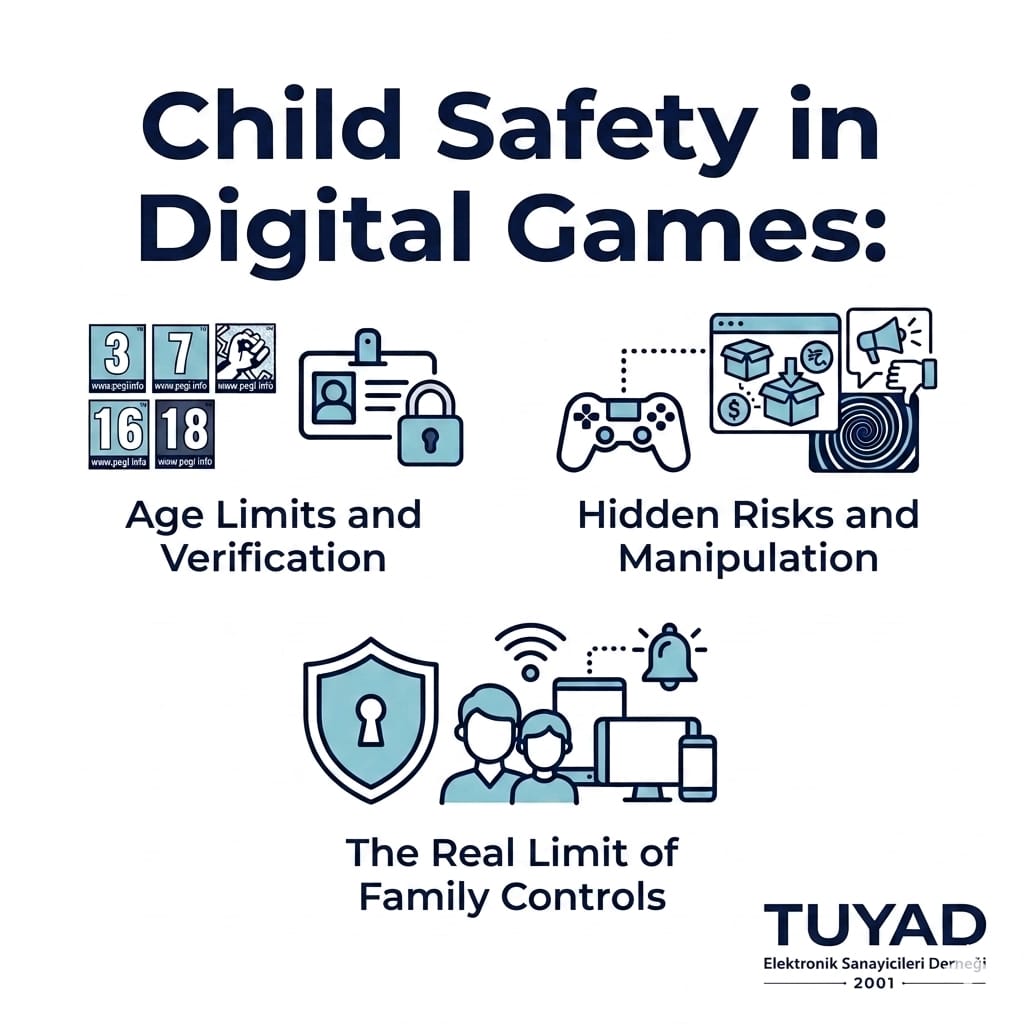
Child Safety in Digital Games: Age Limits, Hidden Risks, and the Real Limits of Family Control
Digital games are no longer just entertainment products; they are a large digital ecosystem where children socialize, spend money, build identities, and sometimes become open to manipulation. Mobile games, computer and console games, and multiplayer productions played over the internet have turned into a global industry reaching billions of users. According to Newzoo’s 2025 data, the global gaming market has reached a revenue of 188.8 billion dollars and approximately 3.6 billion players; about 55 percent of the revenue comes from mobile games. In the same report, the number of mobile players is estimated at approximately 3 billion, PC players at 936 million, and console players at 645 million.
The situation is also striking in terms of Turkey. According to TÜİK’s “Survey on the Use of Information Technologies by Children 2024,” the rate of children who state that they play digital games is 74 percent. This rate shows that the issue of gaming should be addressed not only as a “leisure habit,” but together with topics such as child safety, consumer rights, data privacy, and mental health.
When popular games are examined, productions where children and young people are intensely present include Fortnite, Minecraft, Roblox, Counter-Strike 2, League of Legends, Valorant, EA Sports FC, PUBG, Royal Match, Pokémon GO, Coin Master and similar games. In Newzoo’s 2026 ranking of monthly active PC users, Counter-Strike 2, Minecraft, Roblox, Fortnite and League of Legends are at the top, while on the mobile side games such as Pokémon GO, Royal Match, Coin Master and PUBG are in strong positions in different revenue categories.
How Valid Are Age Restrictions?
When it comes to age restrictions in games, the best-known systems are PEGI, based in Europe, ESRB, based in the USA, and the IARC system used in digital stores. PEGI indicates the suitability of content to age with labels such as 3, 7, 12, 16 and 18; it also uses warnings such as violence, fear, bad language, gambling, online interaction and in-game purchases. ESRB, in addition to classifications such as “Everyone,” “Teen,” “Mature 17+,” provides interaction warnings such as “in-game purchases,” “users interact,” and “shares location.” IARC is an automatic age rating infrastructure used globally for digital games and applications.
However, the critical problem here is this: age labeling and age verification are not the same thing. A game being PEGI 12 or ESRB Teen does not mean that a child cannot access that game. If the child uses an adult account, enters the date of birth incorrectly, has a family payment card registered, or platform settings are not configured correctly, the age label often remains only as an informative warning. For this reason, the real effect of age restrictions depends on the control mechanism established together by the game company, application store, device manufacturer and the family.
How Are Children Manipulated in Games?
One of the most common manipulation methods directed at children is that in-game economies obscure the feeling of real money. Virtual currencies, diamonds, tokens, chests, costumes and temporary campaigns abstract the money spent by the child. Messages such as “only today,” “last chance,” “special package,” “your friends bought it,” “don’t fall behind your team” trigger the feelings of scarcity, belonging and competition.
Another risk area is loot boxes, that is, random reward boxes and chance-based digital rewards. The child spends money without knowing what they will receive; this structure can create psychologically gambling-like expectation loops. In the European Parliament’s 2025 evaluations regarding children’s online safety, loot boxes, dark design patterns, addictive design and commercial manipulations directed at children are listed among special risk areas.
Dark design patterns are not seen only on purchase screens. Daily login rewards, pressure not to break streaks, limited-time events, “battle pass” systems, infinite scrolling logic, automatic matchmaking, continuous notifications and fear of social exclusion are also used to keep children in the game longer. A 2025 academic study has revealed that interface manipulations are widespread in popular free children’s applications and that on average more than one deceptive design pattern exists in applications.
Financial and Psychological Harms
The most visible examples of financial harms are unauthorized in-game purchases, accidental expenditures and the child’s inability to comprehend the difference between virtual money and real money. The U.S. Federal Trade Commission’s Epic Games/Fortnite file is striking in this regard: Epic Games accepted a settlement of 520 million dollars due to allegations related to children’s privacy and dark design patterns; 245 million dollars of this amount was allocated to consumer refunds due to misleading payment designs. The FTC announced in 2025 that the total of refund payments to Fortnite players approached approximately 200 million dollars.
Psychological harms are more complex. In the World Health Organization’s ICD-11 classification, “gaming disorder” is defined with symptoms such as loss of control over gaming, giving more priority to gaming than other activities, and continuing despite negative consequences; for diagnosis, significant functional loss and continuity are generally required. This does not mean that every child who plays a lot of games is addicted; however, if school success, sleep, family relationships, physical activity and social life are deteriorating, the risk should be taken seriously.
Social risks in online games are also large. Voice chat, written messaging, private room invitations, user-generated content and interaction with strangers increase the risks of cyberbullying, inappropriate language, fraud, harassment and grooming. In Ofcom’s 2025 report on children and parent media use, it is stated that a significant portion of children aged 8–17 have been exposed to offensive or harmful behaviors through online games.
Where Does the System Fail?
Some of the gaps originate from game companies. Many games, despite knowing the presence of child players, establish their revenue model on in-game purchases, random rewards, aggressive notifications, social pressure and continuous event cycles. Age control mostly relies on user declaration. Spending limits, chat safety, advertisement distinction, data collection and matching algorithms are not sufficiently transparent for most users.
The second gap is in game stores and device ecosystems. Although Apple, Google, Xbox and PlayStation offer parental control tools, these remain ineffective when not set correctly. Apple can link children’s purchase and download requests to parental approval with “Ask to Buy.” Google Play parental controls provide restrictions on content downloads and purchases; however, Google states that purchase approvals are only valid through the Google Play billing system. Xbox Family Settings offer time and content management on console and Windows, while there are cases where settings do not cover mobile games. PlayStation family management provides controls such as chat, user-generated content and monthly spending limits.
The third gap is fragmented control on the family side. The child may use different accounts on phone, tablet, console and computer. Even if the parent restricts only device time, in-game chat, spending, adding friends, watching live streams or communication on side platforms such as Discord may continue. For this reason, “screen time” alone is not a sufficient security criterion.
What Should Be Done?
From the sector perspective, the priority should be to make child accounts safe by default. Private messaging should be closed for children, spending limits should start from zero, loot box and random reward mechanics should be disabled in child accounts, advertisements should be separated by age, data collection should be minimized and algorithms should be opened to independent audit. The European Union’s Digital Services Act guidelines for 2025 also emphasize that privacy should be high by default, the impact of recommendation systems on children, blocking/muting tools and measures against harmful commercial practices should be taken.
From the family perspective, the basic approach should be to configure before banning. The child should not be given an adult account; a child account should be opened on every platform, age should be entered correctly, purchase approval should be activated, registered cards should be limited, voice chat and receiving messages from strangers should be turned off, in-game spending limits should be set, PEGI/ESRB warnings should be read and the game should be experienced together. Most importantly, children should be given digital awareness with questions such as “why does this game call you back every day?”, “why is this package limited?”, “do you really know what will come out of this box?”
As a result, digital games are not harmful on their own; in fact, when chosen correctly, they can be valuable in terms of problem solving, coordination, socialization and creativity. The problem is that children are placed into an economy of money, data and attention designed for adults without sufficient protection. A safe gaming ecosystem is the shared responsibility not only of families but also of game companies, platforms, device manufacturers, regulatory institutions and the education system.
In this context, TUYAD holds an important position as one of the sector representatives that closely follows developments in digital games, broadcasting technologies, mobile and online platforms and end-user safety. TUYAD President Hayrettin Özaydın follows current studies regarding risks that children may encounter in digital environments, age restriction applications, family control systems and technological security solutions; he continues his contacts with relevant stakeholders and awareness activities for the sector to develop in a more conscious, safe and sustainable manner. TUYAD – Association of Telecommunications, Satellite and Electronics Industrialists and Businesspeople – continues to contribute to studies that will shed light on the future of the sector by emphasizing that the opportunities provided by technology should be handled together with user rights, child safety and social responsibility principles.


