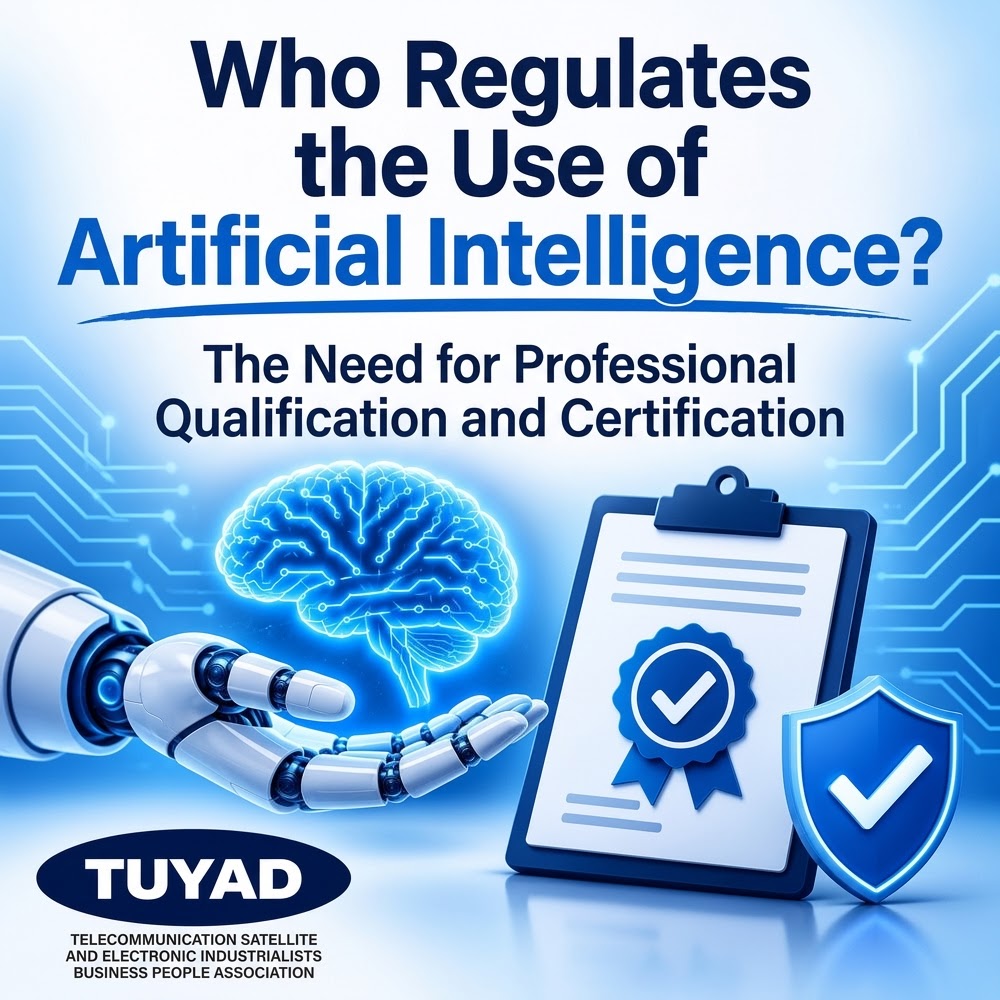
Who Oversees the Use of Artificial Intelligence? The Need for Professional Qualifications and Certification
AI assistants are now being used across virtually every profession, from drafting contracts and maintaining accounting records to preparing patient information materials and writing software code. However, in Türkiye, there is currently no mechanism to demonstrate, measure or audit whether individuals using these tools in their professional work do so accurately, securely and in compliance with legal requirements.
Academic education is expanding rapidly, and we strongly support this development. However, the gap highlighted in this article is a different one: the need for a standard that defines the conditions for the professional use of artificial intelligence, a certification issued in accordance with that standard, and an institutional structure responsible for overseeing it. Drawing on official sources, this article examines the current situation, international examples and a model that could be established through the Vocational Qualifications Authority (MYK).
Academic Education Is Expanding; We Support This Development
Over the past five years, artificial intelligence education in Türkiye has become increasingly institutionalized, representing a valuable development for the sector.
-
Universities: Hacettepe University’s Artificial Intelligence Engineering programme admitted its first students in the 2019–2020 academic year. According to a statement by YÖK President Prof. Dr. Erol Özvar, the number of AI-related programmes has reached 785 across 171 universities. For the 2026–2027 academic year, programmes such as History and Artificial Intelligence, Philosophy and Artificial Intelligence, and Business Administration and Artificial Intelligence have also been introduced.
-
Schools: The Ministry of National Education (MEB) has developed an elective course titled “Artificial Intelligence Applications” for 7th and 8th grade students, with 72 hours of instruction at each grade level. On 17 June 2025, MEB also implemented the “Artificial Intelligence in Education Policy Document and Action Plan (2025–2029).”
However, these educational initiatives either train specialists who develop artificial intelligence or provide students with basic awareness. The way millions of people currently use AI in their professional lives remains outside the supervision of any institution. A diploma certifies knowledge; it does not certify the conditions under which that knowledge is applied in professional practice.
The Main Gap: There Is No Mechanism to Oversee Professional Use
Today, there is no established set of rules governing how a lawyer enters client information, a physician enters patient data or a certified public accountant enters company records into an AI assistant. Nor is there a professional standard defining whether AI-generated outputs must be verified or which tasks cannot be delegated to artificial intelligence.
Existing regulations address this gap only partially:
-
MYK standards focus on AI developers: The national occupational standards established by MYK in the field of artificial intelligence define professions that develop AI technologies, such as “Artificial Intelligence Programmer (Level 5)” and “Artificial Intelligence Systems Analyst (Level 5).” However, there is no corresponding standard for individuals who use artificial intelligence within their own professions.
-
The KVKK guide provides guidance, not binding professional qualifications: On 24 November 2025, the Personal Data Protection Authority published its guide titled “Generative Artificial Intelligence and the Protection of Personal Data (15 Questions).” This guide is valuable; however, there is no examination or certification system to measure whether users actually understand and comply with these principles.
-
Training certificates lack a common standard of recognition: The content of training programmes available on the market is not standardized, and their quality is not consistently monitored. Two “artificial intelligence certificates” issued by different institutions do not necessarily represent the same level of competence to an employer.
As a result, the professional use of artificial intelligence is left to individual curiosity, institutional goodwill and chance. When an incorrect output or a data breach occurs, there is no documented record demonstrating whether the employee possesses the necessary competence in this area.
How Is the Use of Artificial Intelligence Documented and Overseen Around the World?
Three main approaches stand out internationally in the oversight of artificial intelligence use: legal obligations, institutional certification and government-supported training programmes with monitored quality standards.
| Model | What does it regulate? | Who does it cover? |
|---|---|---|
| EU Artificial Intelligence Act, Article 4 | Organisations that provide or deploy AI systems are required to ensure a sufficient level of AI literacy among their staff. The obligation took effect on 2 February 2025, and enforcement began on 2 August 2026. Organisations are expected to keep records of the training provided. | All organisations operating in the EU and the individuals working on their behalf, including Turkish exporters. |
| ISO/IEC 42001 | Published in December 2023, this is the first internationally recognized, certifiable standard for AI management systems. Certification is granted through independent third-party audits. | Organisations, not individuals. |
| Singapore SkillsFuture | Approximately 1,600 government-supported AI courses; more than 105,000 participants in 2025. Course quality and outcome indicators are monitored, and assessment scores are published publicly. | Working adults. |
When these three models are considered together, a missing link becomes apparent: there is a standard that certifies organisations (ISO/IEC 42001) and a law that imposes obligations on organisations (the EU AI Act). However, none of these examples provides a national qualification system that certifies and oversees an individual’s professional competence in using artificial intelligence. Thanks to its MYK infrastructure, Türkiye is among the countries that could take a pioneering role in this field.
Türkiye Has the Foundations in Place: The Action Plan and MYK Infrastructure
Two essential elements required to establish an auditable mechanism in Türkiye are already in place: a policy objective and an institutional infrastructure.
-
Policy objective: Türkiye’s Artificial Intelligence Action Plan (2026–2030) entered into force through Circular No. 2026/9, published in the Official Gazette dated 18 August 2026 and numbered 33344. The plan’s “Fark Et” (Recognize) pillar focuses on AI literacy. The National Artificial Intelligence Literacy and Safe Use Programme aims to reach 5 million citizens within 24 months, enable citizens to assess their AI literacy levels through e-Government, and make basic AI training mandatory for public-sector personnel.
-
Institutional infrastructure: MYK has developed 943 national occupational standards and 694 national qualifications across 27 sectors. A “Digital Transformation and Artificial Intelligence Advisory Board” has also been established within the institution.
-
A proven oversight model: Through Additional Article 1 of Law No. 5544 on the Vocational Qualifications Authority, vocational qualification certification has been made mandatory for certain occupations classified as hazardous or highly hazardous. According to official statements, this certification requirement has reduced occupational accidents in the relevant professions by 25%.
The Action Plan’s literacy objective aims to raise awareness among broad segments of society. However, professional use requires more than awareness; it must be linked to measurable and auditable qualifications. The model successfully applied by MYK in occupational safety could also be adapted to AI use involving data security and professional responsibility.
The professional use of artificial intelligence should be defined, certified and monitored within the existing National Qualifications System. We propose a five-step model:
1. National Occupational Standard: A graded national occupational standard and national qualification should be developed for “Working with AI Assistants.” The standard should cover secure data entry, output verification, personal data protection, copyright and ethical principles, as well as human oversight.
2. Sector-Specific Modules: Additional units should be defined according to the specific risks of professions in fields such as law, healthcare, finance, accounting, education, public services and software development.
3. Authorized Examination and Certification: Examinations should be conducted by certification bodies authorized by MYK, as is the case with other professions. Given the rapid pace of technological change, certificates should be renewed at specified intervals.
4. Gradual Mandatory Certification in High-Risk Areas: In fields involving personal data, health data or legally consequential work, certification requirements should be introduced through a phased transition process, similar to the model applied in hazardous occupations. In other fields, certification should remain voluntary and encouraged through incentives.
5. Organisations and Individuals Together: Individual certification should be complemented by organisational management system certifications such as ISO/IEC 42001. This would also enable companies operating in the EU market to demonstrate compliance with the AI literacy obligations under the EU Artificial Intelligence Act through documented evidence.
Academic education trains specialists who will develop artificial intelligence, and these efforts should continue and be strengthened. However, there is no mechanism defining and overseeing the conditions under which millions of people use AI in their professional lives. MYK’s established infrastructure and the objectives of the 2026–2030 Action Plan demonstrate that this gap can be addressed in Türkiye in the near future.
TUYAD is a non-governmental organization that not only identifies the oversight gap in the professional use of artificial intelligence but also takes responsibility for helping to address it. Our association is ready to contribute its sectoral expertise, the practical experience of its members and its institutional communication network to support the development, secure use and standardization of artificial intelligence and AI assistant technologies in Türkiye. MYK legislation enables sectoral organizations to participate in the preparation of national occupational standards through formal protocols. TUYAD is willing to take an active role and contribute to this process.
TUYAD supports every initiative that can benefit the sector and remains committed to maintaining this approach. We are open to cooperation with MYK, YÖK, MEB, the Ministry of Industry and Technology, the Personal Data Protection Authority (KVKK), universities, professional organizations and the private sector on all new initiatives, including the development of occupational standards, the establishment of examination and certification models, the preparation of training programmes and the training of instructors.
We reiterate our call for cooperation with all stakeholders to ensure that Türkiye becomes not merely a country that uses artificial intelligence, but one that uses it securely, responsibly and in an auditable manner.


