
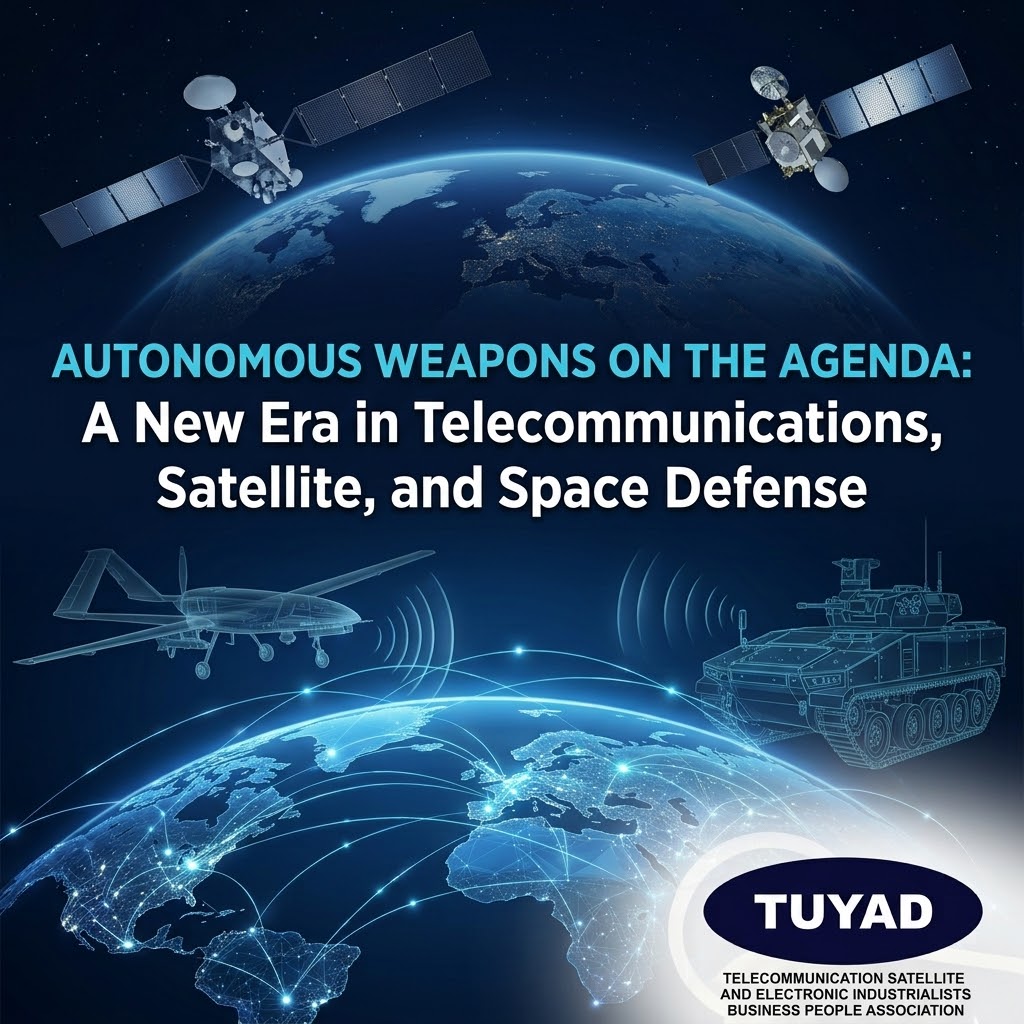
Autonomous Weapons on the Global Agenda:
A New Era for Telecommunications, Satellite Systems and Space Defence
International discussions on autonomous weapons under a convention with 128 States Parties concern not only the future of defence technology but also telecommunications infrastructure, satellite systems and space security. For Türkiye, these developments bring technological opportunities alongside security and competitiveness risks.
Why are autonomous weapons on the global agenda?
Advances in artificial intelligence, robotics and sensor technologies are enabling wider deployment of systems capable of making certain decisions during military operations without direct human intervention. Lethal autonomous weapon systems (LAWS) are generally understood as systems that, under defined conditions, can select and engage targets without direct human intervention. Not every unmanned aerial, ground or maritime vehicle is an autonomous weapon.
These developments raise a fundamental question for international security: Should decisions involving the use of lethal force be made without human control?
Discussions within the United Nations framework, under the Convention on Certain Conventional Weapons (CCW), which has 128 States Parties, seek to develop common rules addressing this question. The conference taking place in Geneva on 16–20 November 2026 is considering legal and technical measures. An expert report agreed in September 2026 provides a basis for further work on human control, international humanitarian law, system reliability and accountability. No binding international agreement prohibiting all autonomous weapons has yet been adopted.
Potential implications for telecommunications infrastructure
The development of autonomous defence systems is increasing the strategic importance of secure communications. Reliable links between military platforms, sensors, command-and-control centres and data processing systems are critical. Electronic warfare, jamming, spoofing and cyberattacks can undermine the safe operation of these systems.
In a joint statement issued in March 2025, the International Telecommunication Union (ITU), International Civil Aviation Organization (ICAO) and International Maritime Organization (IMO) highlighted the risks that interference with satellite navigation signals poses to aviation, maritime activities and telecommunications services.
These developments could create opportunities for telecommunications equipment manufacturers, antenna and radio-frequency (RF) developers, electronics companies and secure communications providers in Türkiye. At the same time, reliance on foreign sources for critical components, supply-chain disruption and cybersecurity vulnerabilities remain significant risks.
Satellite systems and space defence
Satellite technologies support not only broadcasting and communications but also positioning, time synchronisation, observation and military operations. The wider use of autonomous systems may increase demand for dependable satellite links and alternative communications infrastructure.
Disruptions to satellite signals, cyberattacks on ground stations or manipulation of positioning data can affect both civilian and military services. The European Union Agency for Cybersecurity (ENISA) highlighted cybersecurity and supply-chain risks in space systems in its 2025 report.
In space defence, monitoring satellite movements, assessing potential threats and ensuring orbital safety are becoming increasingly important. The European Space Agency’s (ESA) 2026 report identifies mounting collision risks associated with growing satellite populations and space debris. Secure satellite communications, space situational awareness, ground control systems and redundant infrastructure are therefore gaining importance. Nevertheless, the UN discussions on autonomous weapons do not directly regulate all satellite and space activities.
Strategic opportunities and risks for Türkiye
Türkiye has developed substantial engineering and manufacturing capabilities in satellite technology, electronics and defence. The commissioning of TÜRKSAT 6A and the İMECE Earth observation satellite are tangible examples of the country’s progress in satellite technology.
This expertise may create opportunities in secure satellite communications, domestically developed antenna and RF systems, electronic-warfare countermeasures, cybersecurity, sensor technologies and the verification of AI-enabled systems. If new international rules for autonomous systems are developed, demand may also grow for testing, certification, human oversight and trustworthy software.
Three areas of risk stand out for Türkiye:
- Technological dependence: Reliance on external suppliers for critical electronic components, semiconductors and advanced sensors.
- Infrastructure security: The need to protect telecommunications and satellite systems against cyberattacks, electronic warfare and service disruptions.
- International compliance: The possible effects of future legal rules and technical standards on manufacturing, exports and defence cooperation.
Türkiye must therefore focus not only on developing technology, but also on reliability, critical-infrastructure resilience and compliance with international standards.
TUYAD’s industry role and commitment to cooperation
TUYAD closely monitors national and international developments in autonomous systems and the related fields of telecommunications, satellite technology and space security. The association continues to issue announcements and industry assessments to keep stakeholders informed in a timely manner about regulatory discussions, technological trends and emerging opportunities and risks.
In fulfilling its responsibility to represent the industry, TUYAD attaches particular importance to knowledge-sharing and cooperation among public institutions, universities, research organisations and private-sector stakeholders. It remains committed to initiatives that strengthen domestic manufacturing, reduce dependence on external sources in critical technologies, monitor international standards and support secure infrastructure — in the shared interests of the industry and Türkiye.
The debate on autonomous weapons concerns not only the technologies of future warfare but also the reliability of telecommunications and space infrastructure. Türkiye’s principal opportunity lies in developing secure, domestically produced and internationally competitive technologies; the central risk is the deepening of technological dependence and vulnerabilities in critical infrastructure. TUYAD will continue to monitor this transformation, inform the industry, foster stakeholder cooperation and fulfil its responsibility to contribute to Türkiye’s technological capabilities.
TUYAD – Telecommunication Satellite And Electronics Industrialists Business People Association In Turkiye


