
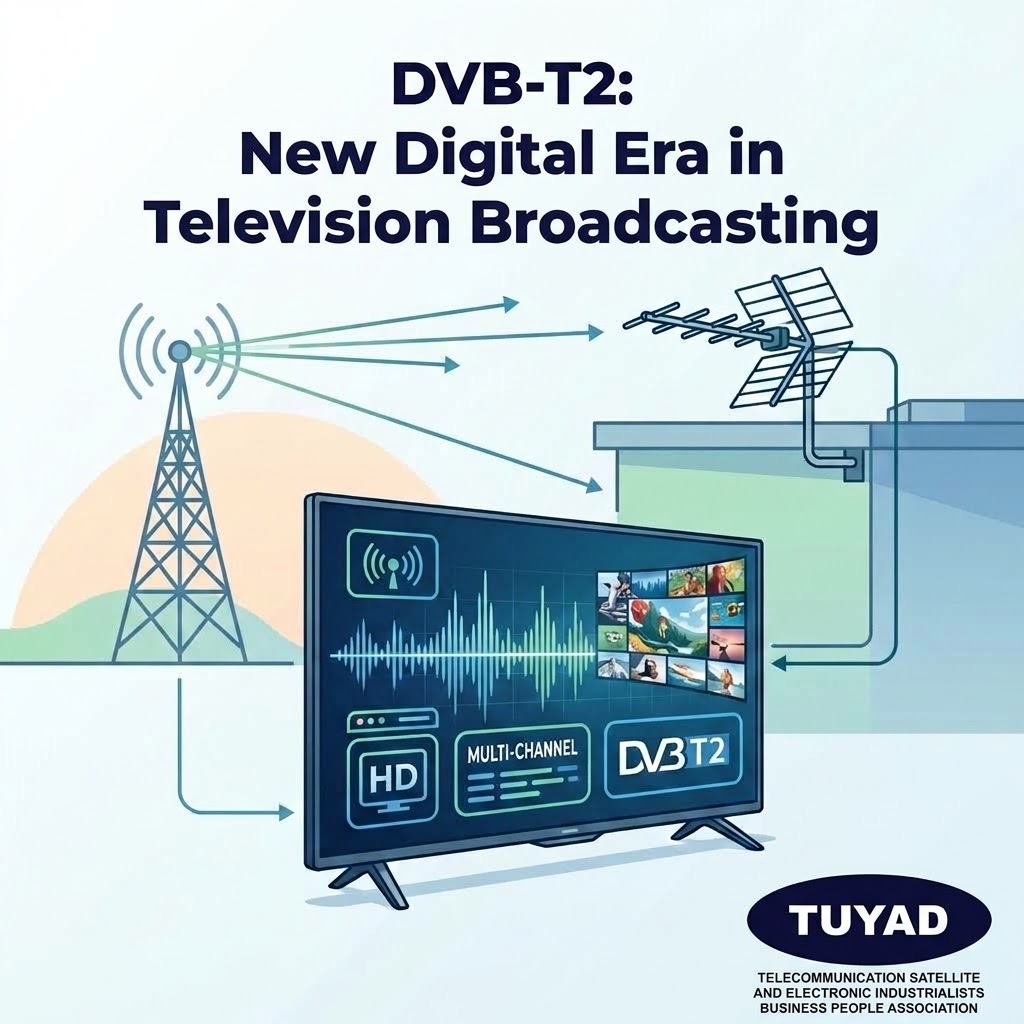
DVB-T2: A New Digital Era in Television Broadcasting
Television broadcasting is undergoing a significant transformationalongside the rapid development of technology. In addition tosatellite, cable, and internet-based television services, terrestrialtelevision broadcasting is also becoming digital. At the centerof this transformation is DVB-T2 technology.
What Is DVB-T2?
DVB-T2 stands for “Digital Video Broadcasting – Second Generation Terrestrial.” In simple terms, it is a next-generationbroadcasting technology that enables television signals to be transmitted digitally through terrestrial transmitters directlyto viewers.
In traditional analogue terrestrial television broadcasting, eachtelevision channel requires a significant amount of frequencycapacity. DVB-T2, however, makes it possible to use theavailable frequency spectrum much more efficiently.
As a result, several television channels can be transmitteddigitally within a single broadcast package. In the broadcastingindustry, this structure is known as a “multiplex.”
Does DVB-T2 Require a Satellite Dish or Internet Connection?
One of the most important advantages of DVB-T2 for consumersis that it does not require either a satellite dish or an internet connection.
DVB-T2 broadcasts are transmitted directly from terrestrialbroadcasting towers to a television antenna.
Depending on the coverage area and signal strength at theviewer’s location, broadcasts may be received using: a smallindoor UHF antenna, a window or balcony antenna or a rooftopantenna.
This means that viewers do not consume internet data or requirean active internet connection to watch television. DVB-T2 can also provide an alternative television reception method in buildings where the installation of satellite dishes is difficult orrestricted.
What Are the Advantages of DVB-T2?
DVB-T2 represents much more than simply replacing analoguebroadcasting with digital transmission. It offers importantadvantages for both broadcasters and viewers.
Thanks to more efficient use of frequency spectrum, a greaternumber of television channels can be transmitted within thesame frequency capacity.
The technology also enables the efficient transmission of high-definition HD television services. With suitable infrastructure andsufficient broadcasting capacity, it can also support higher-resolution television technologies.
Digital transmission significantly reduces many of the imageproblems commonly associated with analogue broadcasting, suchas snow, ghosting, and interference. In areas with sufficient signalstrength, viewers can receive clearer images and more stablesound quality.
Modern digital transmitter systems can also contribute to moreefficient broadcasting infrastructure and, in the long term, helpreduce energy consumption and operating costs.
Is DVB-T2 Being Used in Türkiye?
Türkiye has adopted DVB-T2 as the standard for digitalterrestrial television broadcasting. The Radio and TelevisionSupreme Council of Türkiye, RTÜK, has also prepared theNational DVB-T2 Digital Terrestrial Television Frequency Plan.
Significant developments in DVB-T2 broadcasting have takenplace in Türkiye during 2026. Digital terrestrial televisionbroadcasts from the Çamlıca Tower in Istanbul represent an important step toward the wider deployment of the technology.
According to information published by TUYAD in the February2026 edition of Dijital Yaşam, 17 television channels were beingtransmitted via two DVB-T2 multiplexes from Çamlıca Tower.
The same assessment also stated that work was continuing toexpand digital terrestrial broadcasting infrastructure in majorcities including Ankara, İzmir, Bursa, Adana, Antalya, Gaziantep, Konya, Malatya, and Trabzon.
An important point should be emphasized: DVB-T2 broadcastingin Türkiye is still in a development and deployment phase. Therefore, the number of available channels, frequencies used, and broadcasts that can be received may vary depending on the city and transmitter coverage area. For this reason, it wouldnot be accurate to state that the same number of DVB-T2 channelscan currently be received everywhere in Türkiye.
Can My Television Receive DVB-T2 Broadcasts?
To receive DVB-T2 broadcasts, a television must have a DVB-T2-compatible tuner or receiver.
Many television models manufactured in recent years alreadyinclude DVB-T2 support. Consumers can check the technicalspecifications or user manual of their television for the “DVB-T2” designation.
Users whose televisions do not include DVB-T2 support do not necessarily need to replace their television. Existing televisionscan also receive DVB-T2 broadcasts by using an external DVB-T2 set-top box or receiver.
Viewers with a DVB-T2-compatible television and a suitableantenna can scan for available broadcasts through the television’sterrestrial or digital channel search menu, provided they arelocated within a DVB-T2 coverage area.
Why Is DVB-T2 Important?
Terrestrial broadcasting should not simply be regarded as an alternative to satellite, cable, or internet television. Rather, it is an important broadcasting infrastructure that complements thesetechnologies.
Its ability to deliver television services to large audiences withoutrequiring an internet connection, its efficient use of frequencyspectrum, and its potential to provide a strong nationalbroadcasting infrastructure mean that DVB-T2 is expected to playan increasingly important role in Türkiye’s television broadcastingsector.
Developing Türkiye’s existing terrestrial broadcastinginfrastructure through next-generation digital technologiespresents significant opportunities for viewers, broadcasters, manufacturers, installers, and the wider broadcasting industry.
As TUYAD, we will continue to support the accuratecommunication of next-generation broadcasting technologies, particularly DVB-T2, to both the industry and the public, while encouraging the widespread adoption of suitablereceiver and antenna systems and contributing to thedevelopment of Türkiye’s digital broadcasting infrastructure.
DVB-T2 represents the next generation of television receptionthrough terrestrial antennas and the digital future of terrestrial broadcasting.
TUYAD
Telecommunication Satellite and Electronic IndustrialistsBusiness People Association


